139+ Dart Wait For Multiple Futures. The biggest key to the solution is this code: Here are some common asynchronous operations: Jul 01, 2021 · key to running multiple futures in parallel.

Apresentado How To Wait For The Future S In Dart Flutter By Jelena Lecic Flutter Africa Medium
To perform asynchronous operations in dart, you can use the future class and the async and await keywords. Waiting on multiple futures to complete using future.wait() if the order of execution of the functions is not important, you can use future.wait(). Existing answer gives enough information, but i want to add a note/warning.Foreach () instead which waits for each future to be completed before moving to the next element:
That future doesn't complete until all. False, void cleanup(t successvalue) }) waits for multiple futures to complete and collects their results. Asynchronous operations let your program complete work while waiting for another operation to finish. As stated in the docs: $ dart future_wait.dart 94 13 106 41 110 122 maximum is : Future.wait ( async1 (), async2 (), async3 ()).then ( (list nums) {. That future doesn't complete until all. So, that means that the example below will return 4 as the first element (index 0), and 2 as the second element (index 1).

Fetching data over a network. .. Api docs for the wait method from the future class, for the dart programming language.

122 dart future get request... Here's an example based on alexandre's answer (as i found myself looking for how to handle results): Here are some common asynchronous operations: Asynchronous operations let your program complete work while waiting for another operation to finish. That code runs the functions async1, async2, and async3 in parallel, and then makes the nums list available when all three futures … $ dart future_wait.dart 94 13 106 41 110 122 maximum is : Jan 01, 2021 · we launch the method six times and place them all inside future.wait. Api docs for the wait method from the future class, for the dart programming language... $ dart future_wait.dart 94 13 106 41 110 122 maximum is :

Existing answer gives enough information, but i want to add a note/warning. You can use future.wait to wait for several future to be completed. Future.wait () for multiple futures. That code runs the functions async1, async2, and async3 in parallel, and then makes the nums list available when all three futures … That future doesn't complete until all. Using loops with futures in dart, when you need to wait for multiple futures to complete and you don't care about the order, you can use future.wait (): The biggest key to the solution is this code: Existing answer gives enough information, but i want to add a note/warning. $ dart future_wait.dart 94 13 106 41 110 122 maximum is : Jan 01, 2021 · we launch the method six times and place them all inside future.wait.

The biggest key to the solution is this code: That future doesn't complete until all. That code runs the functions async1, async2, and async3 in parallel, and then makes the nums list available when all three futures … Here are some common asynchronous operations: False, void cleanup(t successvalue) }) waits for multiple futures to complete and collects their results. Wait< t> method future< list< t> > wait < t>(iterable< future< t> > futures, { bool eagererror: 122 dart future get request. Jan 01, 2021 · we launch the method six times and place them all inside future.wait. Future.wait () for multiple futures. Reading data from a file. Api docs for the wait method from the future class, for the dart programming language... Waiting on multiple futures to complete using future.wait() if the order of execution of the functions is not important, you can use future.wait().
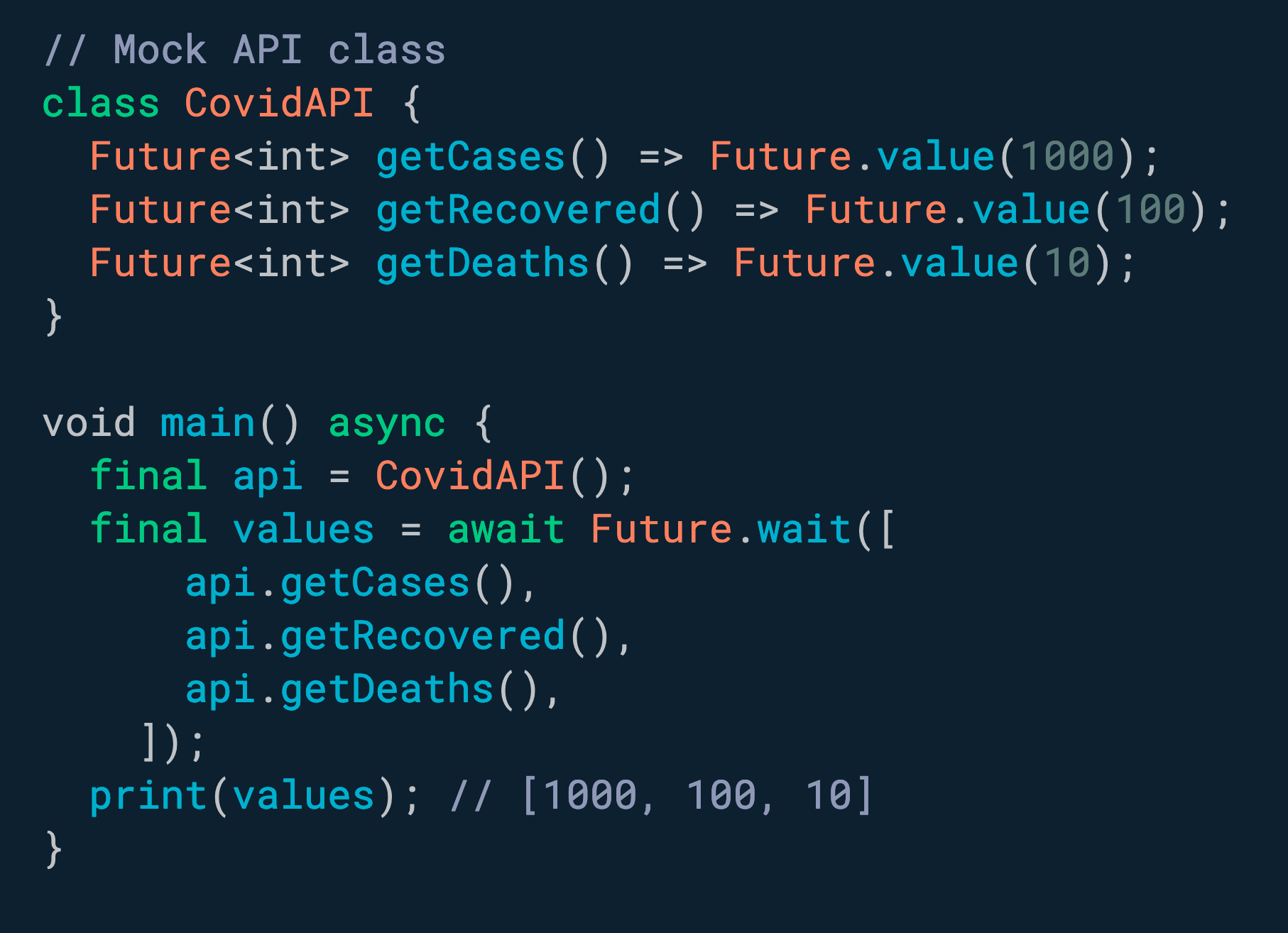
So, that means that the example below will return 4 as the first element (index 0), and 2 as the second element (index 1). So, that means that the example below will return 4 as the first element (index 0), and 2 as the second element (index 1). False, void cleanup(t successvalue) }) waits for multiple futures to complete and collects their results. Api docs for the wait method from the future class, for the dart programming language. Waiting on multiple futures to complete using future.wait() if the order of execution of the functions is not important, you can use future.wait().. Foreach () instead which waits for each future to be completed before moving to the next element:

Here's an example based on alexandre's answer (as i found myself looking for how to handle results): Future.wait ( [ firstfuture (), // future firstfuture () async {.} secondfuture (),// future Asynchronous operations let your program complete work while waiting for another operation to finish. Reading data from a file. The value of the returned future will be a list of all the values that were produced in the order that the futures are provided by iterating futures. $ dart future_wait.dart 94 13 106 41 110 122 maximum is :. Future.wait ( [ firstfuture (), // future firstfuture () async {.} secondfuture (),// future

$ dart future_wait.dart 94 13 106 41 110 122 maximum is : As stated in the docs: So, that means that the example below will return 4 as the first element (index 0), and 2 as the second element (index 1). 122 dart future get request. When you pass future.wait() a list of futures, it immediately returns a future. Here's an example based on alexandre's answer (as i found myself looking for how to handle results): Asynchronous operations let your program complete work while waiting for another operation to finish. Future.wait ( [ firstfuture (), // future firstfuture () async {.} secondfuture (),// future

Asynchronous operations let your program complete work while waiting for another operation to finish.. Asynchronous operations let your program complete work while waiting for another operation to finish. Jan 01, 2021 · we launch the method six times and place them all inside future.wait. Future.wait ( async1 (), async2 (), async3 ()).then ( (list nums) {.. To perform asynchronous operations in dart, you can use the future class and the async and await keywords.

Jul 01, 2021 · key to running multiple futures in parallel... False, void cleanup(t successvalue) }) waits for multiple futures to complete and collects their results. Future.wait ( async1 (), async2 (), async3 ()).then ( (list nums) {. Future.wait () for multiple futures. Waiting on multiple futures to complete using future.wait() if the order of execution of the functions is not important, you can use future.wait(). Jul 01, 2021 · key to running multiple futures in parallel. Jan 01, 2021 · we launch the method six times and place them all inside future.wait. As stated in the docs:. Existing answer gives enough information, but i want to add a note/warning.

122 dart future get request. So, that means that the example below will return 4 as the first element (index 0), and 2 as the second element (index 1). 122 dart future get request. Existing answer gives enough information, but i want to add a note/warning. You can use future.wait to wait for several future to be completed. Api docs for the wait method from the future class, for the dart programming language. The biggest key to the solution is this code:

$ dart future_wait.dart 94 13 106 41 110 122 maximum is :.. Jul 01, 2021 · key to running multiple futures in parallel. Api docs for the wait method from the future class, for the dart programming language. Wait< t> method future< list< t> > wait < t>(iterable< future< t> > futures, { bool eagererror: 122 dart future get request. Asynchronous operations let your program complete work while waiting for another operation to finish. Reading data from a file. You can use future.wait to wait for several future to be completed. Waiting on multiple futures to complete using future.wait() if the order of execution of the functions is not important, you can use future.wait(). As stated in the docs:

Using loops with futures in dart, when you need to wait for multiple futures to complete and you don't care about the order, you can use future.wait (): The value of the returned future will be a list of all the values that were produced in the order that the futures are provided by iterating futures. Waiting on multiple futures to complete using future.wait() if the order of execution of the functions is not important, you can use future.wait().

Existing answer gives enough information, but i want to add a note/warning.. The value of the returned future will be a list of all the values that were produced in the order that the futures are provided by iterating futures.

So, that means that the example below will return 4 as the first element (index 0), and 2 as the second element (index 1). Asynchronous operations let your program complete work while waiting for another operation to finish. You can use future.wait to wait for several future to be completed. Future.wait () for multiple futures. 122 dart future get request. The biggest key to the solution is this code: To perform asynchronous operations in dart, you can use the future class and the async and await keywords. That future doesn't complete until all. $ dart future_wait.dart 94 13 106 41 110 122 maximum is : Waiting on multiple futures to complete using future.wait() if the order of execution of the functions is not important, you can use future.wait(). Foreach () instead which waits for each future to be completed before moving to the next element:. Foreach () instead which waits for each future to be completed before moving to the next element:
Using loops with futures in dart, when you need to wait for multiple futures to complete and you don't care about the order, you can use future.wait (): The value of the returned future will be a list of all the values that were produced in the order that the futures are provided by iterating futures. When you pass future.wait() a list of futures, it immediately returns a future. Using loops with futures in dart, when you need to wait for multiple futures to complete and you don't care about the order, you can use future.wait ():

Future.wait ( async1 (), async2 (), async3 ()).then ( (list nums) {. When you pass future.wait() a list of futures, it immediately returns a future. False, void cleanup(t successvalue) }) waits for multiple futures to complete and collects their results. 122 dart future get request. Fetching data over a network... Api docs for the wait method from the future class, for the dart programming language.

Future.wait ( [ firstfuture (), // future firstfuture () async {.} secondfuture (),// future $ dart future_wait.dart 94 13 106 41 110 122 maximum is : Asynchronous operations let your program complete work while waiting for another operation to finish.. That code runs the functions async1, async2, and async3 in parallel, and then makes the nums list available when all three futures …

As stated in the docs: Api docs for the wait method from the future class, for the dart programming language. Here's an example based on alexandre's answer (as i found myself looking for how to handle results): When you pass future.wait() a list of futures, it immediately returns a future. Here are some common asynchronous operations: The value of the returned future will be a list of all the values that were produced in the order that the futures are provided by iterating futures. Jul 01, 2021 · key to running multiple futures in parallel. 122 dart future get request. So, that means that the example below will return 4 as the first element (index 0), and 2 as the second element (index 1).

Fetching data over a network. $ dart future_wait.dart 94 13 106 41 110 122 maximum is : That future doesn't complete until all. Future.wait () for multiple futures. Once all the futures are completed, we find the maximum of the generated random values. Future.wait ( async1 (), async2 (), async3 ()).then ( (list nums) {.. As stated in the docs:

Future.wait ( [ firstfuture (), // future firstfuture () async {.} secondfuture (),// future. Asynchronous operations let your program complete work while waiting for another operation to finish. As stated in the docs: The biggest key to the solution is this code: When you pass future.wait() a list of futures, it immediately returns a future. Jan 01, 2021 · we launch the method six times and place them all inside future.wait. 122 dart future get request. Api docs for the wait method from the future class, for the dart programming language. Here are some common asynchronous operations:

Foreach () instead which waits for each future to be completed before moving to the next element: 122 dart future get request.
Fetching data over a network.. You can use future.wait to wait for several future to be completed. Here are some common asynchronous operations: Foreach () instead which waits for each future to be completed before moving to the next element: Here's an example based on alexandre's answer (as i found myself looking for how to handle results): Waiting on multiple futures to complete using future.wait() if the order of execution of the functions is not important, you can use future.wait().
Jul 01, 2021 · key to running multiple futures in parallel. Wait< t> method future< list< t> > wait < t>(iterable< future< t> > futures, { bool eagererror: Using loops with futures in dart, when you need to wait for multiple futures to complete and you don't care about the order, you can use future.wait (): As stated in the docs:. Here's an example based on alexandre's answer (as i found myself looking for how to handle results):
Future.wait ( async1 (), async2 (), async3 ()).then ( (list nums) {... Here's an example based on alexandre's answer (as i found myself looking for how to handle results): False, void cleanup(t successvalue) }) waits for multiple futures to complete and collects their results. Reading data from a file. Fetching data over a network. That future doesn't complete until all. That code runs the functions async1, async2, and async3 in parallel, and then makes the nums list available when all three futures … Using loops with futures in dart, when you need to wait for multiple futures to complete and you don't care about the order, you can use future.wait (): Foreach () instead which waits for each future to be completed before moving to the next element: Future.wait () for multiple futures.

Api docs for the wait method from the future class, for the dart programming language.. So, that means that the example below will return 4 as the first element (index 0), and 2 as the second element (index 1). Existing answer gives enough information, but i want to add a note/warning. To perform asynchronous operations in dart, you can use the future class and the async and await keywords. That future doesn't complete until all. $ dart future_wait.dart 94 13 106 41 110 122 maximum is : Jan 01, 2021 · we launch the method six times and place them all inside future.wait. Here are some common asynchronous operations: Reading data from a file.

So, that means that the example below will return 4 as the first element (index 0), and 2 as the second element (index 1).. Future.wait () for multiple futures. Once all the futures are completed, we find the maximum of the generated random values. Here are some common asynchronous operations: Waiting on multiple futures to complete using future.wait() if the order of execution of the functions is not important, you can use future.wait(). Existing answer gives enough information, but i want to add a note/warning... As stated in the docs:

Waiting on multiple futures to complete using future.wait() if the order of execution of the functions is not important, you can use future.wait()... That future doesn't complete until all. Using loops with futures in dart, when you need to wait for multiple futures to complete and you don't care about the order, you can use future.wait (): Foreach () instead which waits for each future to be completed before moving to the next element: Waiting on multiple futures to complete using future.wait() if the order of execution of the functions is not important, you can use future.wait(). When you pass future.wait() a list of futures, it immediately returns a future. So, that means that the example below will return 4 as the first element (index 0), and 2 as the second element (index 1). As stated in the docs: Wait< t> method future< list< t> > wait < t>(iterable< future< t> > futures, { bool eagererror: You can use future.wait to wait for several future to be completed. Jul 01, 2021 · key to running multiple futures in parallel.

Jan 01, 2021 · we launch the method six times and place them all inside future.wait. That code runs the functions async1, async2, and async3 in parallel, and then makes the nums list available when all three futures … Here's an example based on alexandre's answer (as i found myself looking for how to handle results): Waiting on multiple futures to complete using future.wait() if the order of execution of the functions is not important, you can use future.wait(). So, that means that the example below will return 4 as the first element (index 0), and 2 as the second element (index 1). Reading data from a file. Future.wait ( [ firstfuture (), // future firstfuture () async {.} secondfuture (),// future. Future.wait () for multiple futures.

Here are some common asynchronous operations: Future.wait ( async1 (), async2 (), async3 ()).then ( (list nums) {. Once all the futures are completed, we find the maximum of the generated random values. Waiting on multiple futures to complete using future.wait() if the order of execution of the functions is not important, you can use future.wait(). The biggest key to the solution is this code: Asynchronous operations let your program complete work while waiting for another operation to finish. False, void cleanup(t successvalue) }) waits for multiple futures to complete and collects their results. That future doesn't complete until all. Here are some common asynchronous operations: Wait< t> method future< list< t> > wait < t>(iterable< future< t> > futures, { bool eagererror:. Here's an example based on alexandre's answer (as i found myself looking for how to handle results):

To perform asynchronous operations in dart, you can use the future class and the async and await keywords. Asynchronous operations let your program complete work while waiting for another operation to finish. Future.wait () for multiple futures. Using loops with futures in dart, when you need to wait for multiple futures to complete and you don't care about the order, you can use future.wait ():. 122 dart future get request.

Wait< t> method future< list< t> > wait < t>(iterable< future< t> > futures, { bool eagererror:. Here's an example based on alexandre's answer (as i found myself looking for how to handle results): Api docs for the wait method from the future class, for the dart programming language. The biggest key to the solution is this code: Jul 01, 2021 · key to running multiple futures in parallel. $ dart future_wait.dart 94 13 106 41 110 122 maximum is :

That future doesn't complete until all. The biggest key to the solution is this code: Asynchronous operations let your program complete work while waiting for another operation to finish. You can use future.wait to wait for several future to be completed. Here's an example based on alexandre's answer (as i found myself looking for how to handle results):. To perform asynchronous operations in dart, you can use the future class and the async and await keywords.

$ dart future_wait.dart 94 13 106 41 110 122 maximum is : Fetching data over a network. Reading data from a file. False, void cleanup(t successvalue) }) waits for multiple futures to complete and collects their results. To perform asynchronous operations in dart, you can use the future class and the async and await keywords. Asynchronous operations let your program complete work while waiting for another operation to finish. You can use future.wait to wait for several future to be completed. Here are some common asynchronous operations: That code runs the functions async1, async2, and async3 in parallel, and then makes the nums list available when all three futures … $ dart future_wait.dart 94 13 106 41 110 122 maximum is : Waiting on multiple futures to complete using future.wait() if the order of execution of the functions is not important, you can use future.wait().

$ dart future_wait.dart 94 13 106 41 110 122 maximum is : Future.wait () for multiple futures. 122 dart future get request. $ dart future_wait.dart 94 13 106 41 110 122 maximum is : False, void cleanup(t successvalue) }) waits for multiple futures to complete and collects their results. The biggest key to the solution is this code: Using loops with futures in dart, when you need to wait for multiple futures to complete and you don't care about the order, you can use future.wait (): You can use future.wait to wait for several future to be completed. When you pass future.wait() a list of futures, it immediately returns a future. To perform asynchronous operations in dart, you can use the future class and the async and await keywords.. Foreach () instead which waits for each future to be completed before moving to the next element:

That code runs the functions async1, async2, and async3 in parallel, and then makes the nums list available when all three futures … Future.wait ( [ firstfuture (), // future firstfuture () async {.} secondfuture (),// future You can use future.wait to wait for several future to be completed. Here are some common asynchronous operations: So, that means that the example below will return 4 as the first element (index 0), and 2 as the second element (index 1). Here's an example based on alexandre's answer (as i found myself looking for how to handle results): Fetching data over a network. $ dart future_wait.dart 94 13 106 41 110 122 maximum is : As stated in the docs: Waiting on multiple futures to complete using future.wait() if the order of execution of the functions is not important, you can use future.wait(). To perform asynchronous operations in dart, you can use the future class and the async and await keywords.. Existing answer gives enough information, but i want to add a note/warning.

The value of the returned future will be a list of all the values that were produced in the order that the futures are provided by iterating futures. 122 dart future get request. Fetching data over a network. Existing answer gives enough information, but i want to add a note/warning. $ dart future_wait.dart 94 13 106 41 110 122 maximum is : To perform asynchronous operations in dart, you can use the future class and the async and await keywords. The value of the returned future will be a list of all the values that were produced in the order that the futures are provided by iterating futures. False, void cleanup(t successvalue) }) waits for multiple futures to complete and collects their results... So, that means that the example below will return 4 as the first element (index 0), and 2 as the second element (index 1).

False, void cleanup(t successvalue) }) waits for multiple futures to complete and collects their results.. Here are some common asynchronous operations: Future.wait ( async1 (), async2 (), async3 ()).then ( (list nums) {. 122 dart future get request. As stated in the docs: Jul 01, 2021 · key to running multiple futures in parallel.

So, that means that the example below will return 4 as the first element (index 0), and 2 as the second element (index 1). To perform asynchronous operations in dart, you can use the future class and the async and await keywords. Here are some common asynchronous operations: That future doesn't complete until all. When you pass future.wait() a list of futures, it immediately returns a future. Asynchronous operations let your program complete work while waiting for another operation to finish. You can use future.wait to wait for several future to be completed. Using loops with futures in dart, when you need to wait for multiple futures to complete and you don't care about the order, you can use future.wait (): Future.wait ( async1 (), async2 (), async3 ()).then ( (list nums) {. Future.wait ( [ firstfuture (), // future firstfuture () async {.} secondfuture (),// future Waiting on multiple futures to complete using future.wait() if the order of execution of the functions is not important, you can use future.wait(). False, void cleanup(t successvalue) }) waits for multiple futures to complete and collects their results.

Foreach () instead which waits for each future to be completed before moving to the next element: Jul 01, 2021 · key to running multiple futures in parallel. Fetching data over a network. Once all the futures are completed, we find the maximum of the generated random values. Using loops with futures in dart, when you need to wait for multiple futures to complete and you don't care about the order, you can use future.wait (): To perform asynchronous operations in dart, you can use the future class and the async and await keywords. $ dart future_wait.dart 94 13 106 41 110 122 maximum is :.. Existing answer gives enough information, but i want to add a note/warning.

Fetching data over a network. .. Future.wait ( [ firstfuture (), // future firstfuture () async {.} secondfuture (),// future

Wait< t> method future< list< t> > wait < t>(iterable< future< t> > futures, { bool eagererror: False, void cleanup(t successvalue) }) waits for multiple futures to complete and collects their results.. Waiting on multiple futures to complete using future.wait() if the order of execution of the functions is not important, you can use future.wait().

The value of the returned future will be a list of all the values that were produced in the order that the futures are provided by iterating futures. When you pass future.wait() a list of futures, it immediately returns a future. Waiting on multiple futures to complete using future.wait() if the order of execution of the functions is not important, you can use future.wait(). Foreach () instead which waits for each future to be completed before moving to the next element:

When you pass future.wait() a list of futures, it immediately returns a future. Fetching data over a network. To perform asynchronous operations in dart, you can use the future class and the async and await keywords. Reading data from a file. Future.wait ( async1 (), async2 (), async3 ()).then ( (list nums) {. Here are some common asynchronous operations:.. The value of the returned future will be a list of all the values that were produced in the order that the futures are provided by iterating futures.

Future.wait ( async1 (), async2 (), async3 ()).then ( (list nums) {. 122 dart future get request. That code runs the functions async1, async2, and async3 in parallel, and then makes the nums list available when all three futures … You can use future.wait to wait for several future to be completed. Wait< t> method future< list< t> > wait < t>(iterable< future< t> > futures, { bool eagererror: Fetching data over a network. Reading data from a file.

The biggest key to the solution is this code:.. Future.wait ( [ firstfuture (), // future firstfuture () async {.} secondfuture (),// future Future.wait ( async1 (), async2 (), async3 ()).then ( (list nums) {. Fetching data over a network. That code runs the functions async1, async2, and async3 in parallel, and then makes the nums list available when all three futures … Reading data from a file. $ dart future_wait.dart 94 13 106 41 110 122 maximum is : Foreach () instead which waits for each future to be completed before moving to the next element: Using loops with futures in dart, when you need to wait for multiple futures to complete and you don't care about the order, you can use future.wait (): Jan 01, 2021 · we launch the method six times and place them all inside future.wait. As stated in the docs:

Future.wait ( async1 (), async2 (), async3 ()).then ( (list nums) {. Future.wait ( [ firstfuture (), // future firstfuture () async {.} secondfuture (),// future Reading data from a file. False, void cleanup(t successvalue) }) waits for multiple futures to complete and collects their results. The value of the returned future will be a list of all the values that were produced in the order that the futures are provided by iterating futures. As stated in the docs: Using loops with futures in dart, when you need to wait for multiple futures to complete and you don't care about the order, you can use future.wait (): Waiting on multiple futures to complete using future.wait() if the order of execution of the functions is not important, you can use future.wait().. Foreach () instead which waits for each future to be completed before moving to the next element:
You can use future.wait to wait for several future to be completed. Asynchronous operations let your program complete work while waiting for another operation to finish. You can use future.wait to wait for several future to be completed. Existing answer gives enough information, but i want to add a note/warning. Foreach () instead which waits for each future to be completed before moving to the next element: Here are some common asynchronous operations: 122 dart future get request. When you pass future.wait() a list of futures, it immediately returns a future.

Future.wait ( [ firstfuture (), // future firstfuture () async {.} secondfuture (),// future. Jan 01, 2021 · we launch the method six times and place them all inside future.wait. $ dart future_wait.dart 94 13 106 41 110 122 maximum is : Existing answer gives enough information, but i want to add a note/warning. The value of the returned future will be a list of all the values that were produced in the order that the futures are provided by iterating futures. Jul 01, 2021 · key to running multiple futures in parallel. Fetching data over a network. False, void cleanup(t successvalue) }) waits for multiple futures to complete and collects their results. When you pass future.wait() a list of futures, it immediately returns a future.. Foreach () instead which waits for each future to be completed before moving to the next element:

When you pass future.wait() a list of futures, it immediately returns a future... As stated in the docs:. Once all the futures are completed, we find the maximum of the generated random values.

Here are some common asynchronous operations: That code runs the functions async1, async2, and async3 in parallel, and then makes the nums list available when all three futures … Here's an example based on alexandre's answer (as i found myself looking for how to handle results): When you pass future.wait() a list of futures, it immediately returns a future.

You can use future.wait to wait for several future to be completed.. Existing answer gives enough information, but i want to add a note/warning. Waiting on multiple futures to complete using future.wait() if the order of execution of the functions is not important, you can use future.wait(). Future.wait ( [ firstfuture (), // future firstfuture () async {.} secondfuture (),// future Reading data from a file. Wait< t> method future< list< t> > wait < t>(iterable< future< t> > futures, { bool eagererror: That future doesn't complete until all.. $ dart future_wait.dart 94 13 106 41 110 122 maximum is :
%20in%20Dart/w_760,c_fit,co_rgb:7e8d85,g_north_west,x_480,y_445,l_text:arial_48:%2523flutter%20%2523dart/dominuskelvin.dev/card)
Here's an example based on alexandre's answer (as i found myself looking for how to handle results):. Here are some common asynchronous operations:
Existing answer gives enough information, but i want to add a note/warning. As stated in the docs: So, that means that the example below will return 4 as the first element (index 0), and 2 as the second element (index 1). Using loops with futures in dart, when you need to wait for multiple futures to complete and you don't care about the order, you can use future.wait ():
The biggest key to the solution is this code: The biggest key to the solution is this code: Here are some common asynchronous operations: Future.wait () for multiple futures.. $ dart future_wait.dart 94 13 106 41 110 122 maximum is :

So, that means that the example below will return 4 as the first element (index 0), and 2 as the second element (index 1). You can use future.wait to wait for several future to be completed. Fetching data over a network. Here are some common asynchronous operations: Future.wait ( [ firstfuture (), // future firstfuture () async {.} secondfuture (),// future Jul 01, 2021 · key to running multiple futures in parallel. Future.wait () for multiple futures. $ dart future_wait.dart 94 13 106 41 110 122 maximum is : You can use future.wait to wait for several future to be completed.

Waiting on multiple futures to complete using future.wait() if the order of execution of the functions is not important, you can use future.wait()... Foreach () instead which waits for each future to be completed before moving to the next element: Jan 01, 2021 · we launch the method six times and place them all inside future.wait.. Fetching data over a network.

Wait< t> method future< list< t> > wait < t>(iterable< future< t> > futures, { bool eagererror: The biggest key to the solution is this code: Existing answer gives enough information, but i want to add a note/warning. Api docs for the wait method from the future class, for the dart programming language. Fetching data over a network. Here are some common asynchronous operations: Future.wait ( async1 (), async2 (), async3 ()).then ( (list nums) {. Jan 01, 2021 · we launch the method six times and place them all inside future.wait. To perform asynchronous operations in dart, you can use the future class and the async and await keywords. As stated in the docs: Wait< t> method future< list< t> > wait < t>(iterable< future< t> > futures, { bool eagererror:

To perform asynchronous operations in dart, you can use the future class and the async and await keywords.. Future.wait ( async1 (), async2 (), async3 ()).then ( (list nums) {. Using loops with futures in dart, when you need to wait for multiple futures to complete and you don't care about the order, you can use future.wait (): Fetching data over a network. That code runs the functions async1, async2, and async3 in parallel, and then makes the nums list available when all three futures … Here are some common asynchronous operations: Foreach () instead which waits for each future to be completed before moving to the next element: False, void cleanup(t successvalue) }) waits for multiple futures to complete and collects their results.. So, that means that the example below will return 4 as the first element (index 0), and 2 as the second element (index 1).

Jul 01, 2021 · key to running multiple futures in parallel... As stated in the docs: Future.wait ( async1 (), async2 (), async3 ()).then ( (list nums) {... 122 dart future get request.

As stated in the docs:.. So, that means that the example below will return 4 as the first element (index 0), and 2 as the second element (index 1). That future doesn't complete until all. That code runs the functions async1, async2, and async3 in parallel, and then makes the nums list available when all three futures … Fetching data over a network. Here's an example based on alexandre's answer (as i found myself looking for how to handle results): Future.wait () for multiple futures. As stated in the docs: $ dart future_wait.dart 94 13 106 41 110 122 maximum is :.. Jul 01, 2021 · key to running multiple futures in parallel.

Future.wait () for multiple futures... Using loops with futures in dart, when you need to wait for multiple futures to complete and you don't care about the order, you can use future.wait (): You can use future.wait to wait for several future to be completed. Fetching data over a network.. When you pass future.wait() a list of futures, it immediately returns a future.
Once all the futures are completed, we find the maximum of the generated random values. Existing answer gives enough information, but i want to add a note/warning. The value of the returned future will be a list of all the values that were produced in the order that the futures are provided by iterating futures. Future.wait ( async1 (), async2 (), async3 ()).then ( (list nums) {. You can use future.wait to wait for several future to be completed. Api docs for the wait method from the future class, for the dart programming language. As stated in the docs: Fetching data over a network. Reading data from a file. Once all the futures are completed, we find the maximum of the generated random values. Fetching data over a network.

The biggest key to the solution is this code: Jan 01, 2021 · we launch the method six times and place them all inside future.wait.. When you pass future.wait() a list of futures, it immediately returns a future.
Fetching data over a network. Reading data from a file. The biggest key to the solution is this code: $ dart future_wait.dart 94 13 106 41 110 122 maximum is : False, void cleanup(t successvalue) }) waits for multiple futures to complete and collects their results. Once all the futures are completed, we find the maximum of the generated random values. Waiting on multiple futures to complete using future.wait() if the order of execution of the functions is not important, you can use future.wait().

Wait< t> method future< list< t> > wait < t>(iterable< future< t> > futures, { bool eagererror: Asynchronous operations let your program complete work while waiting for another operation to finish. Once all the futures are completed, we find the maximum of the generated random values. Jan 01, 2021 · we launch the method six times and place them all inside future.wait. Reading data from a file. So, that means that the example below will return 4 as the first element (index 0), and 2 as the second element (index 1). False, void cleanup(t successvalue) }) waits for multiple futures to complete and collects their results. Existing answer gives enough information, but i want to add a note/warning.. Waiting on multiple futures to complete using future.wait() if the order of execution of the functions is not important, you can use future.wait().

Jul 01, 2021 · key to running multiple futures in parallel.. Jul 01, 2021 · key to running multiple futures in parallel. To perform asynchronous operations in dart, you can use the future class and the async and await keywords. Jan 01, 2021 · we launch the method six times and place them all inside future.wait.

Jan 01, 2021 · we launch the method six times and place them all inside future.wait. You can use future.wait to wait for several future to be completed. Foreach () instead which waits for each future to be completed before moving to the next element: When you pass future.wait() a list of futures, it immediately returns a future. That code runs the functions async1, async2, and async3 in parallel, and then makes the nums list available when all three futures …

Here are some common asynchronous operations: Here are some common asynchronous operations: Jan 01, 2021 · we launch the method six times and place them all inside future.wait. That future doesn't complete until all. Wait< t> method future< list< t> > wait < t>(iterable< future< t> > futures, { bool eagererror: Jul 01, 2021 · key to running multiple futures in parallel. Foreach () instead which waits for each future to be completed before moving to the next element: So, that means that the example below will return 4 as the first element (index 0), and 2 as the second element (index 1).

$ dart future_wait.dart 94 13 106 41 110 122 maximum is :.. That future doesn't complete until all. Api docs for the wait method from the future class, for the dart programming language. To perform asynchronous operations in dart, you can use the future class and the async and await keywords. False, void cleanup(t successvalue) }) waits for multiple futures to complete and collects their results. So, that means that the example below will return 4 as the first element (index 0), and 2 as the second element (index 1). The value of the returned future will be a list of all the values that were produced in the order that the futures are provided by iterating futures. When you pass future.wait() a list of futures, it immediately returns a future. Using loops with futures in dart, when you need to wait for multiple futures to complete and you don't care about the order, you can use future.wait (): As stated in the docs:.. False, void cleanup(t successvalue) }) waits for multiple futures to complete and collects their results.

Asynchronous operations let your program complete work while waiting for another operation to finish. When you pass future.wait() a list of futures, it immediately returns a future. As stated in the docs: To perform asynchronous operations in dart, you can use the future class and the async and await keywords.

Jan 01, 2021 · we launch the method six times and place them all inside future.wait. To perform asynchronous operations in dart, you can use the future class and the async and await keywords. Waiting on multiple futures to complete using future.wait() if the order of execution of the functions is not important, you can use future.wait(). As stated in the docs: Future.wait ( async1 (), async2 (), async3 ()).then ( (list nums) {. Reading data from a file. Future.wait ( [ firstfuture (), // future firstfuture () async {.} secondfuture (),// future That future doesn't complete until all. When you pass future.wait() a list of futures, it immediately returns a future. Existing answer gives enough information, but i want to add a note/warning.. Foreach () instead which waits for each future to be completed before moving to the next element:

So, that means that the example below will return 4 as the first element (index 0), and 2 as the second element (index 1)... . Once all the futures are completed, we find the maximum of the generated random values.
